
Off-Topic Post: Why I Stopped Injecting Botulism Into My Face
There's a spiritual angle, I promise.

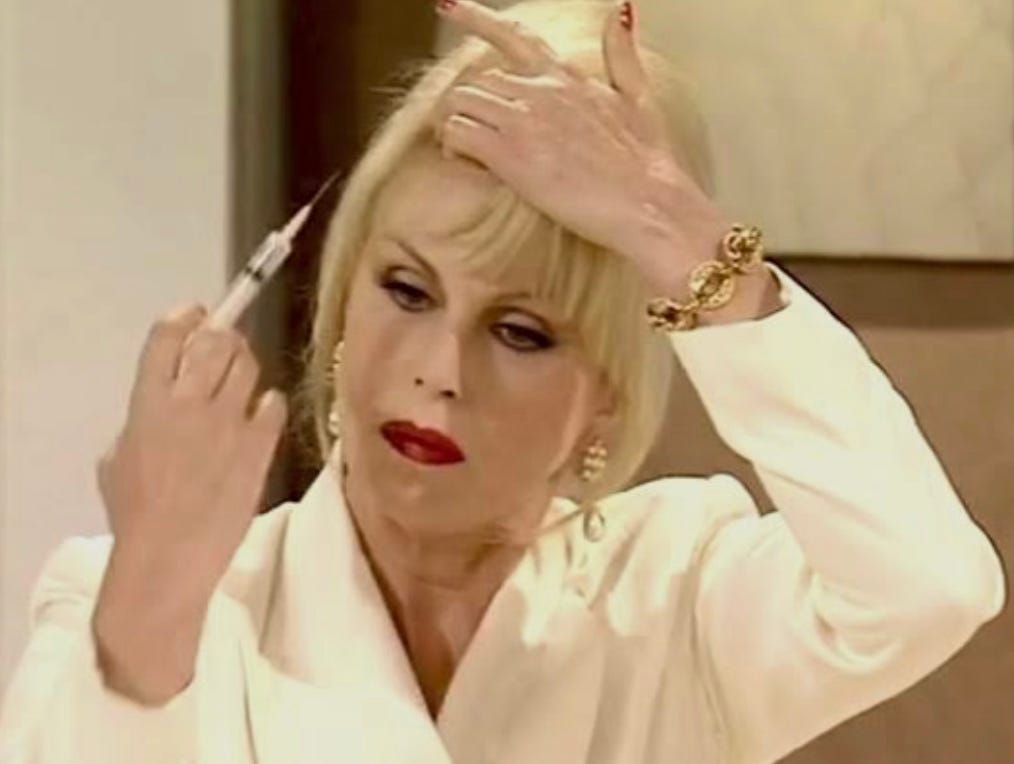
Dear subscribers: This is an off-the-cuff personal post I was inspired to write based upon the surprising number of reactions I received to my comment on this amazing essay. I decided to elaborate my position, which definitely has a spiritual component. But if it’s not your thing, I get it. I’ll be back to my usual art/literature/cultural commentary next month.
***
I never gave a second thought to aging until it caught up with my face.
That nice, tight stomach I had in my teens and twenties went bye-bye in my thirties, when I carried twins to term then delivered via C-Section. Some women mourn the changes in their body post-pregnancy, but my squishy new midsection didn’t bother me much. That’s what Spanx are for, right?
I had the same phlegmatic attitude towards my hair turning gray in my forties. No, I didn’t enjoy those wiry silver hairs that started curling from my eyebrows, the little bastards . But c’est la vie; I figured just grab some Clairol and a brow pencil and get over it.
Yet somehow, around when I hit fifty, my face started looking its age and it unsettled me. I could shove my midsection behind a spandex waistband and dye my hair to conceal the gray. But I couldn’t do much about the skin beneath my eyes, which began to take on the texture of a crepe party streamer that had been trampled underfoot. Neither could I do much about the double furrows between my brows — those frown lines known in medi-spa parlance as “the elevens.” Mine were too pronounced to pass for a delicate Arabic eleven; they were more like a bold Roman numeral two.
By now, we’re all familiar with gender dysphoria. Well, for the first time in my life, I experienced what the mental health industry now calls “age dysphoria” and what I call, “Shit! I’m old!” I knew I was middle-aged; two adult children make it hard to avoid that fact. I knew I had done lots of “big person” things in the preceding decades: marriage, child-rearing, house-buying, working the family business, supporting elderly parents. But for all that, whenever I caught my reflection, it always caused a jolt of disbelief. Internally, I perceived myself as younger.
This is a common reaction, caused by the gap between our chronological and subjective age. I’ve read that “middle-aged adults in Western societies feel 20 percent younger than their actual number of years.” I guess I tend to extremes, because for me it’s closer to 40 percent, give or take a few points. I’m in my mid-50s but feel 35-ish. Interestingly enough, my 83-year-old mother has Alzheimer’s and she’s convinced she’s not a day older than 60. Maybe she and I are just wired for a subjective age setting that’s about 20 years off the mark.
But back to my wizened face.
I decided to try botox as a way to bring my subjective age closer to the age of the face I saw in the mirror — or at least that’s the reason I told myself. Yes, it was expensive, and the idea of paying someone to shoot botulism into my skin was objectively weird. But I reasoned it would quell some of the dismay I felt over the sense that the subjective me and the external me no longer “matched.”
Some of you reading are internally groaning over this last paragraph. I understand. I’m not proud that I got a little botox. I’ll give myself credit, though, for sticking to just a little botox and resisting the sadistic psychological warfare of medi-spa upselling. Being subjected to the medi-spa upsell is akin to being a sorority pledge in one of those old-school hazings where the sisters circle your cellulite with Magic Marker, then crowd around you, screaming and pointing, Ewwwww!
My first appointment, for instance, the NP commented on my “very thin lips,” then offered to inject them with filler. (Side question: Why, in the 21st century, are we still clinging to 19th-century physiognomy pseudoscience equating thin lips with bitchiness? I mean, we stopped believing bumps on peoples’ heads meant anything.) Another NP helpfully pointed out my nascent marionette lines and also offered filler, “but only if I was bothered” by looking like a puppet. Some people, she shared, were “really, really bothered” by marionette lines, but it was “totally okay” if I wasn’t. I refused the filler, got my botox jabs, then spent a good twenty minutes staring into the rearview mirror of my car, pondering just how much I resembled the Heat Miser from The Year Without a Santa Claus.

I endured the upselling tactics because, initially at least, I liked the botox. My crow’s feet softened, my forehead looked smooth, and my “elevens” became faint. With repeated injections, it seemed I could avoid the dreaded perma-crease between the brows, the one that had distinguished my grandmother and my mother before me. I definitely didn’t look 20 years younger, but I could pass for someone in her 40s who was well-rested and not stressed. I stopped fretting over a few wrinkles, freeing up that headspace for more worthy preoccupations.
But as time went on, as the years ticked by and I grew older, an unexpected thing happened: a reverse occurred and I grew more fixated on my face than I had pre-botox. From the moment I handed the medi-spa receptionist my credit card for another 600-700 dollar round (my wrinkles are fighters), the worrying would begin.
Did the botox work, or were my elevens still going rogue and asserting themselves? Did the botox inadvertently make one of my eyebrows higher than the other, so that my resting expression was that of the Skeptical Emoji? 🤨 Did I need more botox to fix that? Did the botox merit the $658.00 I’d paid? Did the injectress use bona fide botox or some expired or watered-down crap? Was my face a $658.00 face, an authentic Louis Vuitton Speedy — seasons old, sure, but in excellent used condition on eBay? Or was my face a cheap Temu knock-off that was already beginning to show wear?
What was the value of my face?
This is, fundamentally, the reason I quit botox: I became alienated from my own face. The cycle of paying-for-freezing caused me to regard my face as something separate and external, as opposed to something organically, inherently me. I began to view my face with the same distance and scrutiny as a product, a SKU. And as with any product or SKU, I wondered if my face was “worth it.”
I use the term SKU because SKUs are what industries assign to individual products that share a standard set of attributes. Make no mistake, a botoxed face is a standardized face. The shared attributes of botoxed faces are smoothness, stillness. I wouldn’t say “youth”, exactly; I looked less lined but still post-menopausal, and I don’t think Nicole Kidman’s fooling anyone about her age.
But I would include “wealthy” as an attribute. An unsullied smoothness on the face of any over-45 White woman has become a recognizable indicator of botox, and botox has become so commonplace that we all know how obscenely expensive it is. Hence, a botoxed face signals money; it’s a designer good, like a Chanel bag or a Cartier love bracelet. And money signals that not only are your needs met but your desires are covered, such that you never have to wrinkle your face over a rent hike, or your kid’s college tuition, or even the ridiculously over-priced (and quite frankly, stupid) cocktail you just ordered.
But lots of women getting botox aren’t rich!, you might counter. Of course not: Like all designer goods, botox is aspirational. With a neurotoxined face, you aspire to a life of ease, a succession of victorious milestones, beautiful vacations, and upscale dining experiences. You might strive and suffer (for love, family, career or any of the million reasons to strive and suffer), but you sure as hell don’t want to look like you do. In short, you aspire to an Instagram-worthy life, all pleasantness and celebration — the life of a princess. I’d say “Disney princess,” but damn, those Disney princesses sure do make facial expressions.
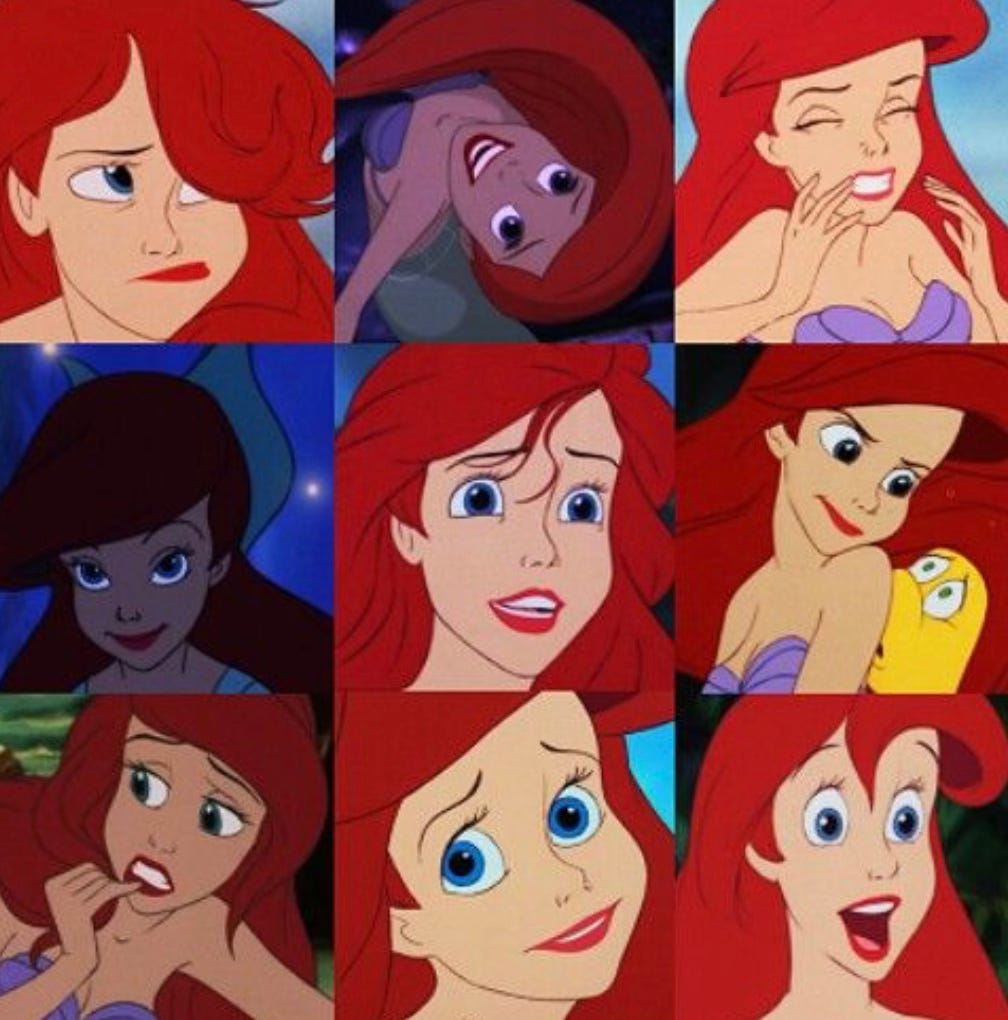
Father Karine’s post astutely describes how botox is a manifestation of feminine narcissism, which in turn is fed by the feelings of inferiority women internalize from the industrial-beauty complex.
I agree, but I think there’s something more primal at work, too — at least there was for me. In my comment to the post, I expressed it generally as follows: “I realized that my discomfort with looking older had something to do with not wanting to look as if I had suffered or been through anything difficult, ever. Which had something to do with not wanting to suffer or go through anything difficult, ever.” Generally speaking, I have what Buddhists call “The 84th Problem”: I don’t want to have any problems.
What this specifically means is, at root, I don’t want to experience the change of loss, which means I don’t want to experience death. Many women rightfully point out that a lined face means you’ve lived, with all the highs and lows, joys and sorrows that entails. But it also unavoidably means — and I realize this sounds comically morbid — you’re closer to dying. You’re inching towards an end, and as you inch your window of available time narrows and certain opportunities necessarily foreclose.
Aging and death mean some things you really want to happen are not going to happen for you. Even more cheerfully, aging and death mean some things you really didn’t want to happen might happen anyway. Earlier I mentioned that I liked how botox staved off the “perma-crease” that distinguished both my grandmother and mother. After a long and painful decline, my grandmother died of Alzheimer’s; my mother is now enduring her own long and painful decline from the same disease. Like them, I carry the APOE-e4 gene. And now, like them, I have a perma-crease between my brows that always gives me a look of consternation, even when I’m entirely chill.
I liked how botox got rid of that crease. Today, whenever I see that crease, a part of my brain remembers how my uncle started showing signs of Alzheimer’s at 60, and another part of my brain starts ghoulishly calculating how much time I have left. I can’t help but associate that crease with my faulty genetic history and probable cause of demise.
I don’t love it.
And yet, I’ve come to give that ugly mother of a crease my grudging respect. It’s a living memento mori, etched upon my face. It’s my fleshy reminder that I am flesh, that my days on earth are finite, and in that sense it is profoundly useful. Remembering I am finite snaps me out of my mental static and forces me into the direct experience of the present moment. It encourages me to marshal my energy towards fulfilling God’s purpose for me, which doesn’t always dovetail with my own expectations. Not to get too hokey about it, but that crease is the embodiment of the plea of Psalm 90: “So teach us to number our days, that we may apply our hearts unto wisdom.”
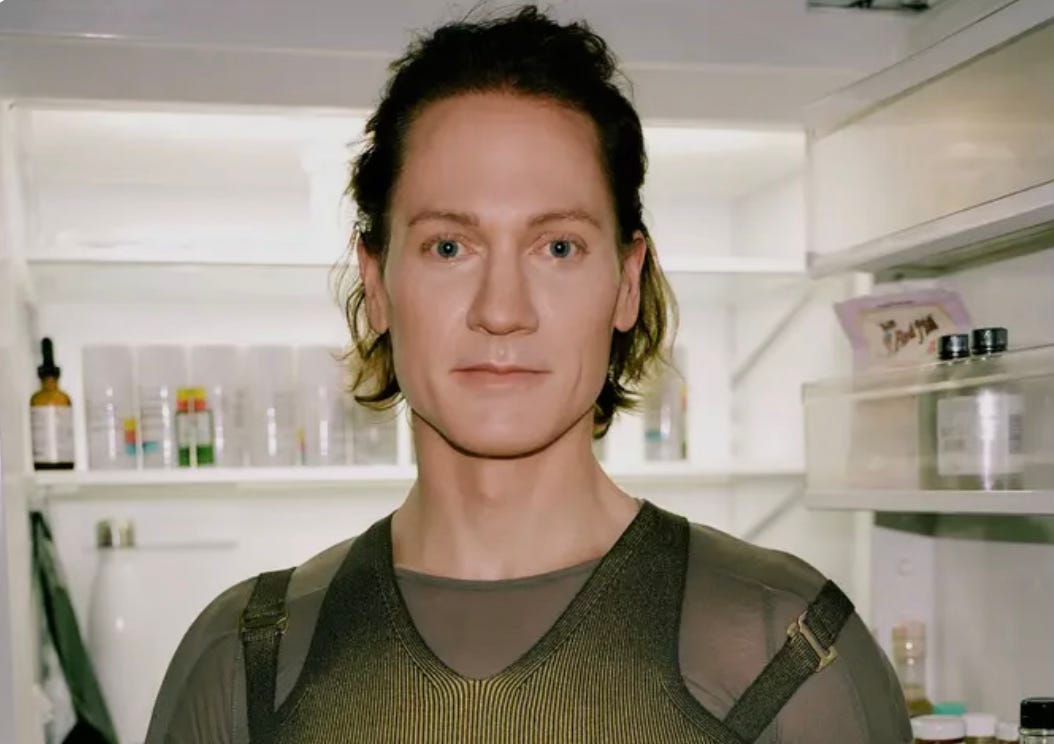
Advances in technology and medicine can seduce you into the belief that your days are not numbered but limitless. A quick Grok search shows the number of centenarians has increased over fourfold since 2000, to above 700,000 globally. When I was growing up, teen pregnancy was common but it was rare to encounter a woman giving birth over 40. Today, thanks to assisted reproductive technology, more babies are being born to women over 40 than to teenagers. Nootropics, bio-hacking, and longevity treatments that span everything from NR pills to hyperbaric oxygen therapy promise to not only slow aging but reverse it. With just a few million dollars and a bazillion daily supplements, Bryan Johnson may have reversed his biological age by 5 years. (As is obvious from photos, Johnson also receives botox injections. Including in his penis).
And now, AI is trying to convince us that when you finally go, you don’t really go. Your digital essence simply gets uploaded to the AI slop-o-matic, churned through an algo, then spit out so that you can live on for eternity trapped in an iPhone. You’ve heard of the Gates of Hell? Try the Gates of Cell.
I decided to reject botox as a way of rejecting the seductive lie of “forever young.” But please don’t take that to mean I’ve figured out all the psycho-emotional, moral angles of an aging face. I still struggle with these issues and am maddeningly inconsistent on them. For instance: If I quit botox, why haven’t I quit dyeing my hair? Why do I continuing buying expensive facial serums containing “growth factors”, including a recent purchase of Skinmedica’s TNS Recovery Complex? (I got it ON SALE with a GIFT CERTIFICATE, okay? Don’t judge me too severely.) Shouldn’t I just say to hell with all “anti-aging”?
(Fun fact: The “growth factors” in TNS products were harvested from cells taken from a newborn’s foreskin decades ago. There’s a lot of talk amongst the very online about “The Longhouse.” Well, I can’t think of a more dystopian example of long-housing than middle-aged White women slathering their faces with goo derived from a baby boy’s foreskin in hopes of eliminating their crow’s feet.)
In sum: My forehead is creeping into Gordon Ramsey territory, and while a feminist might urge me to be “proud” of that fact, all I can muster is a stoic Welp. Watcha gonna do? After all, the alternative — a face that’s a SKU — isn’t so hot, either. And so watcha gonna do is about the best I can do. Watcha gonna do is also the credo perfectly conveyed by this facial expression, courtesy of Tilly Norwood, the AI-generated actress:

Look at those forehead lines. Damn her! She’ll never wrinkle.
Greatly enjoyed this personal discussion. I think it's enough if you show the people around you that you respect them enough to care about how you look.